Back to blog
Teacher Productivity

Teacher burnout is real: How AI tools reduce administrative overload

Teacher burnout is not a motivation problem — it is a workload problem. When grading, planning, documenting, and reporting consume your evenings and weekends, something has to give. AI tools can take the administrative weight off your shoulders so you can focus on what you became a teacher to do: teach.

Updated February 10, 2026

What you'll learn

  • The real scope of the teacher burnout crisis
  • Which tasks AI can take off your plate
  • How automation protects your time and energy
  • Practical steps to reduce workload today

Key benefits

  • Reclaim evenings and weekends
  • Reduce repetitive administrative tasks by hours
  • Maintain quality while working less
  • Protect your long-term career sustainability
1

Why teacher burnout is a systemic crisis

The numbers are stark. Surveys in 2025 and 2026 consistently show that over half of teachers have considered leaving the profession, with workload cited as the number one reason. Teachers report working 50 to 60 hours per week, with evenings and weekends consumed by grading, planning, documenting, and reporting. This is not sustainable — and the consequences are devastating.

Burnout does not just harm teachers — it harms students. Burned-out teachers are less patient, less creative, and less emotionally available. They rely on worksheets instead of engaging lessons because they do not have time or energy for anything more. The students who need the most support get the least of it, because their teachers are running on empty. Solving burnout is not a luxury — it is an educational imperative.

2

Understanding the administrative overload

Teacher burnout is driven by specific, identifiable tasks that consume disproportionate time. Understanding which tasks drain your energy most is the first step toward reclaiming it.

📝

Grading and Feedback

Grading is the single largest time drain for most teachers. A class of 30 students with weekly assessments means hundreds of items to grade per month — each requiring attention, accuracy, and constructive feedback.

📋

Assessment Creation

Creating quizzes, tests, rubrics, and formative checks from scratch for every unit, every class, every semester takes hours of careful design work that repeats endlessly.

📊

Data Tracking and Reporting

Documenting student progress, compiling report card comments, tracking behavior data, and generating reports for administrators and parents adds another invisible layer of work.

How AI reduces administrative burden step by step

1

Automate Assessment Creation

AI generates curriculum-aligned quizzes, tests, and rubrics in minutes instead of hours. You review and customize rather than building from scratch.

2

Speed Up Grading

AI grades objective assessments instantly and provides draft feedback for subjective responses. You finalize rather than starting from zero on every paper.

3

Generate Feedback at Scale

AI produces personalized feedback for each student based on their specific responses. You review and adjust rather than writing 30 unique feedback paragraphs.

4

Compile Data Automatically

AI tracks student performance data, identifies trends, and generates progress summaries. Report card season becomes manageable instead of overwhelming.

5

Plan Lessons Faster

AI generates lesson plan frameworks aligned to your curriculum. You customize and add your teaching expertise rather than structuring from a blank page.

3

Practical strategies for reducing workload with AI

Adopting AI is not about replacing everything at once. These strategies help you reduce workload gradually, starting with the tasks that drain you most:

Identify your top three time drains

Track your time for one week. Where do you spend the most non-teaching hours? Grading? Planning? Documenting? Start your AI adoption with those specific tasks for maximum impact.

Tip: Most teachers discover that grading and assessment creation consume 40 to 60 percent of their non-teaching time. These are exactly the tasks AI handles best.

Batch your AI-assisted tasks

Instead of creating assessments one at a time, batch-generate a week or month of content in one session. AI makes batching practical because generation is fast.

Tip: A 30-minute Sunday session generating the week's assessments with AI replaces five separate hour-long evening sessions creating them manually.

Use AI feedback as a first draft, not a final product

AI-generated feedback gives you a solid starting point. Spend your energy personalizing and adjusting rather than writing from scratch. This cuts feedback time dramatically.

Tip: Many teachers report that reviewing and tweaking AI feedback takes about one-third the time of writing feedback from scratch — same quality, much less effort.

Set boundaries that technology enables

AI makes it possible to finish work during work hours. Use the time savings to set firm boundaries: no grading after dinner, no planning on weekends. Protect the time you reclaim.

Tip: The time savings only matter if you actually take the time back. Set a "shutdown time" and stick to it. AI makes this realistic, not aspirational.
4

The cost of ignoring burnout

Burnout is not just tiredness — it is a clinical syndrome characterized by emotional exhaustion, depersonalization, and reduced professional efficacy. Teachers experiencing burnout become less effective, less empathetic, and more likely to leave. And when experienced teachers leave, students lose the mentors who know them best.

The financial cost is enormous too. Teacher turnover costs school districts billions annually in recruitment, onboarding, and lost institutional knowledge. But the human cost is greater — talented, passionate people who entered education to make a difference find themselves overwhelmed by paperwork and leave the students who need them most.

Emotional exhaustion leads to disengagement

When teachers are exhausted, they withdraw emotionally from students. Relationships suffer, classroom culture deteriorates, and the joy that drives great teaching disappears.

Quality declines under workload pressure

Overwhelmed teachers cut corners — not because they want to, but because there are not enough hours. Assessments become simpler, feedback becomes shorter, and differentiation disappears.

Talented teachers leave the profession

The most skilled teachers have the most career options. When burnout hits, they are the first to leave — creating a brain drain that harms the entire profession.

5

So what to do?

This is exactly why TeachersFlow exists. We built a platform specifically designed to take the most time-consuming administrative tasks off your plate — so you can protect your energy, sustain your career, and focus on the teaching that matters.

Why TeachersFlow fights teacher burnout

⏱️

Hours Back Every Week

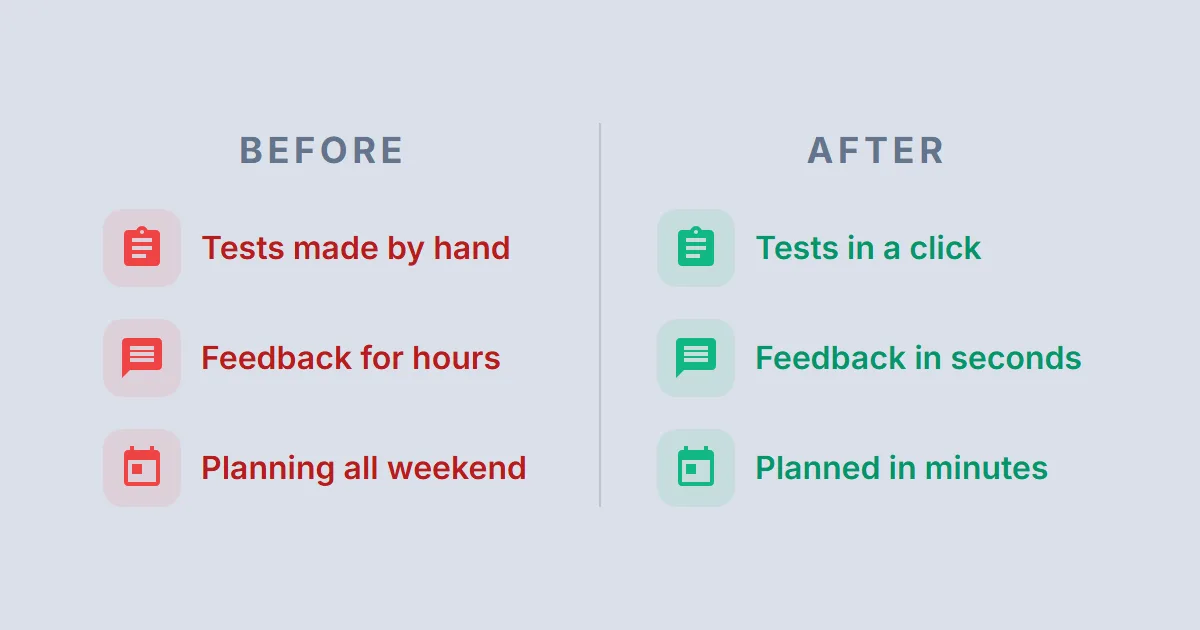
TeachersFlow automates assessment creation, grading, and feedback generation — the three biggest time drains teachers face. Real teachers report saving 5 to 10 hours per week.

🎯

Quality Without the Overtime

AI-generated assessments and feedback maintain high quality standards without requiring evening and weekend work. You deliver the same quality in less time.

💪

Sustainable Teaching Career

By eliminating administrative overload, TeachersFlow helps you maintain the energy, creativity, and passion that brought you to teaching — not just this year, but for your entire career.

Why TeachersFlow protects your time and energy

TeachersFlow was built by people who understand that teacher burnout is a workload problem with a technology solution. Every feature is designed to take repetitive, time-consuming administrative work off your plate — grading, assessment creation, feedback writing, data tracking, and lesson planning. Reclaim your evenings, protect your weekends, and sustain a career that makes a difference.

Continue your learning journey

AI-powered lesson planning: Creating effective lesson plans in minutes

Discover how AI-powered lesson planning tools help teachers create comprehensive, effective lesson plans quickly through automated planning and objective generation.

Read article

Mastering rubric design: Creating effective assessment criteria

Discover how to create effective assessment rubrics that provide clear criteria, improve grading consistency, and enhance student learning.

Read article

Backward design in lesson planning: Starting with assessment goals

Discover how backward design (Understanding by Design) helps teachers create effective lessons by starting with learning outcomes and assessment goals.

Read article

Differentiated instruction made easy

Discover how AI-powered tools make differentiated instruction practical and effective through personalized learning paths.

Read article

Data-driven teaching: Using analytics to improve student outcomes

Discover how to use student performance data and learning analytics to make informed teaching decisions.

Read article

Real-time feedback in education: Immediate response strategies

Discover how to provide instant, actionable feedback to students that enhances learning and improves outcomes.

Read article

Time-saving strategies for teachers

Discover proven strategies to save 10+ hours weekly by leveraging AI tools that automate administrative tasks.

Read article

The future of grading: Automated assessment tools that actually work

Discover how AI-powered automated grading tools are transforming education by providing accurate, efficient assessment solutions.

Read article

Building student self-assessment skills: Tools and strategies for reflection

Discover proven strategies and tools for developing student self-assessment skills that promote metacognition and independent learning.

Read article

How to use AI for assessment generation

Learn practical strategies for leveraging AI to create personalized assessments.

Read article

Student engagement with AI

Explore how AI transforms student engagement through personalized learning.

Read article

Advanced AI assessment generation

Learn advanced techniques for creating sophisticated assessments with AI.

Read article

AI training for teachers

Master AI tools to enhance your teaching effectiveness and outcomes.

Read article

AI-powered classroom management

Discover how AI streamlines classroom management and learning environments.

Read article

Collaborative learning with AI

Enhance group work with AI-powered collaborative tools and strategies.

Read article

Complete teacher workflow with AI

Streamline your entire teaching process with AI integration.

Read article

AI-generated fun activity suggestions

Keep students engaged with creative, AI-generated activities.

Read article

Personalized learning with AI

Create individualized learning experiences that adapt to each student.

Read article

Smart classroom organization

Optimize your classroom setup with AI-powered tools and strategies.

Read article

Teaching goals management with AI

Set, track, and achieve your teaching objectives with AI systems.

Read article

Mastering formative assessment with AI

Discover how AI revolutionizes formative assessment with real-time feedback.

Read article

AI-powered student feedback generation

Transform assessment into actionable insights with automated feedback generation.

Read article

From photo to AI feedback generation

Turn test images into instant digital assessments with AI-powered analysis.

Read article

QR code sharing and mobile learning

Instant student access to classroom activities with QR code technology.

Read article

Creating engaging classroom quizzes: How AI generates questions that actually stick

Master AI-powered quiz creation to generate engaging, customizable questions that boost student learning and participation in minutes.

Read article

Organizing students into groups: Data-driven grouping strategies that work

Master strategic student grouping to organize classes effectively, improve collaboration, and maximize learning outcomes with data-driven approaches.

Read article

Gathering real student feedback: Creating questionnaires that improve your teaching

Learn to create effective student feedback forms and questionnaires that reveal genuine student voice and inform instructional improvements.

Read article

Safe participation: Using anonymous polling to build psychological safety in your classroom

Master anonymous voting and polling to create safe participation environments where all students feel comfortable sharing thoughts and contributing to class discussions.

Read article

Understanding student performance data: What your analytics dashboard is really telling you

Learn to interpret student performance dashboards effectively and translate data insights into actionable teaching strategies that improve learning outcomes.

Read article

The complete AI teaching workflow: From lesson planning to grading to feedback

Master an integrated teaching workflow that connects lesson planning, student engagement, assessment, and feedback into one seamless, efficient system.

Read article

Multi-language assessment creation: Supporting diverse classrooms with 20+ languages

Discover how to create assessments in multiple languages to support diverse student populations. Learn strategies for ESL assessment, bilingual education, and multilingual classroom management.

Read article

Observation notes for teachers: Document student behavior effectively

Discover how to create effective observation notes that document student behavior, participation, and learning patterns. Learn strategies for anecdotal records and behavior tracking that inform instruction.

Read article

Reflection questions for students: Deepen learning with metacognition

Discover how to create effective reflection questions that promote metacognition and deep learning. Learn strategies for designing questions that help students reflect on their learning journey and develop critical thinking skills.

Read article

Learning activities generator: Create engaging classroom exercises

Discover how to create effective learning activities that engage students and promote hands-on learning. Learn strategies for generating activities, exercises, and tasks that enhance student understanding and participation.

Read article

Document training for AI: Personalize your teaching assistant

Discover how to train AI on your teaching documents to personalize assessment generation and lesson planning. Learn strategies for document training that make AI-generated content match your unique teaching style.

Read article

Team project management: Collaborative learning made easy

Discover how to create and manage effective team projects that promote collaborative learning. Learn strategies for organizing group work, facilitating teamwork, and tracking collaborative student progress.

Read article

Exit ticket ideas and questions: Quick formative assessment strategies

Discover effective exit ticket ideas and questions that provide quick formative assessment insights. Learn strategies for creating exit tickets that gauge understanding, identify confusion, and inform your next lesson.

Read article

How to grade tests with photos: AI-powered test grading guide

Discover how to grade student tests instantly by taking photos. Learn how AI-powered test grading saves hours while providing accurate grades, detailed feedback, and improvement suggestions.

Read article

Student progress tracking: Monitor growth and achievement over time

Discover how to effectively track student progress and monitor growth over time. Learn strategies for using progress data to inform instruction, identify learning gaps, and improve student outcomes.

Read article

Speech-to-text for teachers: Create assessments faster with voice input

Discover how speech-to-text technology helps teachers create assessments, lesson plans, and educational content faster using voice input. Learn strategies for using voice input to save time and improve efficiency.

Read article

Skills checklist template: Track student competencies effectively

Discover how to create effective skills checklists that track student competencies and mastery. Learn strategies for designing checklists that monitor skill development and support competency-based assessment.

Read article

Teaching goals examples: Set curriculum-aligned objectives

Discover how to create effective teaching goals that align with curriculum standards and learning objectives. Learn strategies for setting goals that enhance assessment generation and lesson planning.

Read article

How to choose the best AI tool for teachers: A practical guide

Learn what to look for when evaluating AI tools for teachers — from privacy and ease of use to curriculum alignment, personalization, and multilingual support.

Read article

Keyword collector activities: Creative brainstorming strategies for any classroom

Discover how keyword collection activities spark creative brainstorming, inclusive ideation, and deeper student engagement across every subject and grade level.

Read article

How AI learns your teaching style: Personalization that actually works

Discover how AI personalization adapts to your teaching style, preferences, and classroom needs — producing better results than one-size-fits-all tools.

Read article

AI vs. traditional assessment: What teachers need to know in 2026

A balanced comparison of AI-powered and traditional assessment methods — covering fairness, time, quality, and consistency to help teachers make informed decisions.

Read article

Making sense of student data: How to use activity results to improve teaching

Learn how to interpret quiz results, questionnaire feedback, voting patterns, and keyword collections to make data-driven teaching decisions that improve student outcomes.

Read article